
RESEARCH OVERVIEW
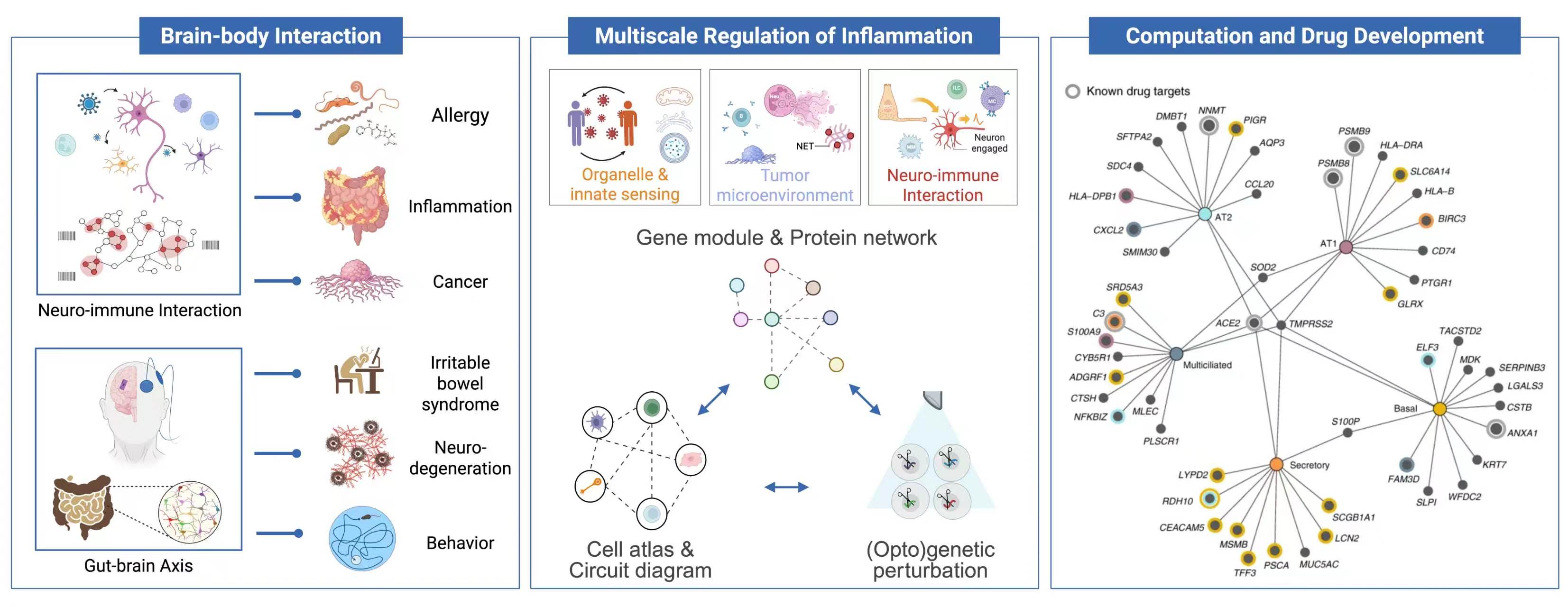
DISCOVERY OF DEVELOPMENTAL ‘ENGRAM’ CELLS WITHIN ENTERIC NEURONS AND THEIR NEUROIMMUNE INTERACTIONS
We constructed platforms tailored for enteric neuroimmunology to systematically dissect neuroimmune interactions and gut–brain connections in inflammation and allergy (RAISIN-V2-Seq,ENS In vivo Perturb-sesq,STARmap PLUS spatial transcriptomics; Science, 2025; Nature, 2023). Using this system, We generated the first multidimensional single-cell atlas of enteric neurons, achieving deep transcriptomic profiling that captures 6,000–9,000 genes per individual neuron across intestinal segments, microbiota states, and inflammatory conditions (Science, 2025; Media report "Gut Neurons Decoded"). We identified a unique progenitor-like neuronal state (developmentally imprinted neurons) in adult mouse ENS. Distinct from canonical neurogenesis, these post-mitotic neurons retain developmental molecular signatures, serve as a neuronal reserve pool, and enable neuronal subtype replenishment via phenotypic remodeling, representing a novel adult ENS plasticity mechanism. These Bglap+ imprinted neurons feature elevated glycolysis and cholesterol biosynthesis, maintaining a poised state for neuronal remodeling and maturation. Microbiota and inflammatory signals drive their transition into functional Dcc+ and Aldh1a3+ inhibitory motor neurons, with Edf1 and Mitf verified as core regulators of this developmental trajectory via in vivo Perturb-seq screening. We also uncovered an immune-sensing pathway in which Nmu+ enteric neurons directly sense type 2 inflammatory signals through CysLTR2 and IL-4/IL-13 receptors, integrating leukotriene and type 2 cytokine signals from the local immune environment into neural outputs. This pathway provides a mechanism linking intestinal inflammation to ENS function and gut–brain communication.
MEMBRANE-ASSOCIATED SIGNALOSOME AS A MOLECULAR DECISION-MAKING HUB FOR ANTIVIRAL IMMUNE RESPONSES
Innate immunity constitutes the first line of defense against enteric pathogens, activated by PRRs (including cGAS, RIG-I, NOD, and inflammasomes) that sense PAMPs and DAMPs, with membrane-bound organelles acting as platforms for innate immune signaling. We developed an organelle-specific proximity labeling technique (Nature Cell Biology, 2015) and identified two TRIM14-centered complexes mediating spatiotemporal type I IFN signaling. The autophagosomal TRIM14-USP14 complex stabilizes cGAS against DNA viruses (Molecular Cell, 2016), and the mitochondrial WHIP-TRIM14-PPP6C complex regulates RIG-I trafficking and activation in RNA virus defense (Molecular Cell, 2017). Using scRNA-seq, we further analyzed SARS-CoV-2 entry receptors (ACE2, TMPRSS2, CTSL) and revealed their expression correlations with age and smoking, while uncovering immune networks and potential therapeutic targets for COVID-19 and ARDS (Nature Medicine, 2021).
NEUTROPHIL-SPECIFIC IMMUNE CHECKPOINT
The tumor microenvironment (TME) comprises cancer cells and non-malignant components including myeloid cells, neurons, stromal cells, adipocytes, and microbes. Key questions remain regarding its spatiotemporal formation, cellular recruitment and remodeling, immune checkpoint regulation underlying T-cell evasion, and microbiome functions in tumorigenesis. We identified Beclin-1 as a neutrophil-specific immune checkpoint in pre-B-ALL (JCI, 2019), supporting the clinical correlation between neutrophil infiltration and poor cancer prognosis. Targeting neutrophils and the Beclin-1-IL-21 axis represents a potential strategy to complement CAR-T therapy, which is often hindered by CD19/CD20 loss in B-ALL. Furthermore, using a myeloid-specific Tak1-deficient mouse model, we discovered that Odoribacter splanchnicus drives Th17 accumulation via IL-1beta/IL-6 to suppress colitis and colon cancer, revealing a microbiota-mediated mechanism in intestinal tumorigenesis (Cell Host & Microbe, 2021).
OPTOGENETICS - SHED LIGHT ON GUT PHYSIOLOGY
We have developed a suite of genetically encoded optogenetic tools paired with upconversion nanoparticles for deep-tissue, long-range light-mediated targeted regulation, including OptoCRAC, LiCa, OptoPB, Sunbody, Moonbody, PhotoSMOC, OptoCAR, and pNUTs. These technologies enabled the investigation of calcium-dependent immune activation, membrane-contact site dynamics, type I IFN signaling, intrabody mechanisms, liquid-liquid phase separation, nucleolar compartmentation, and CAR-T activation (eLife, 2015; Trends in Biotechnology, 2017; Chemical Science, 2017; Advanced Biology, 2021; Nature Communications, 2021; Nature Chemical Biology, 2021; Nucleic Acids Research, 2022), providing foundational tools for understanding gut neuroimmunology. Our pioneering work in optogenetics also led to an invited review on optogenetics and cell physiology in Physiological Reviews, 2022.